Data centre construction is pushing welding and pipe fabrication standards to a new level.
Behind every hyperscale facility sits kilometres of stainless pipework, cooling infrastructure, fire suppression systems and process lines that must operate continuously, often with zero tolerance for failure.
For welders and pipe fabricators, that creates an environment where precision, repeatability and weld integrity are absolutely critical.
This is not general fabrication. Data centre projects demand:
- High purity stainless welding
- Consistent weld quality across hundreds or thousands of joints
- Tight QA and inspection standards
- Minimal rework
- Faster installation timeframes
- Reliable long-term system performance
That pressure is changing the tools and techniques fabricators rely on.
Modern workshops are increasingly moving toward specialised cutting, bevelling, purging, fit-up and orbital welding systems that improve consistency while reducing labour time and operator variability. Companies like Orbimax are supplying the equipment helping fabricators meet those demands.
Pipe Preparation: Where Weld Quality Actually Starts
Most weld defects start long before welding begins.
Poor preparation creates inconsistent fit-up, uneven penetration, alignment issues and unnecessary rework, problems that become amplified across large-scale stainless installations.
In data centre cooling systems, stainless pipework requires:
- Accurate squareness
- Consistent bevel geometry
- Burr-free cuts
- Repeatable preparation across large pipe volumes
That is why professional fabricators are increasingly using dedicated pipe cutting and bevelling systems rather than relying on grinders and manual preparation methods.
High quality prep equipment helps fabricators:
- Reduce fit-up time
- Improve weld consistency
- Minimise grinding and rework
- Increase productivity on large pipe runs
- Maintain tighter tolerances across projects
On larger diameter pipe, efficient prep systems can dramatically reduce labour hours while improving overall weld quality.
In high-spec fabrication, preparation is not a minor step in the workflow. It is the foundation of the final weld result.

Manual and Automated Tee Pulling
Branch connections are one of the biggest labour drains in stainless pipe fabrication.
Traditional cut-and-fit methods are time consuming, inconsistent and heavily dependent on operator skill. Tee pulling systems streamline that process by forming precise branch outlets directly from the parent pipe, reducing fabrication time while improving fit-up consistency.
For workshops fabricating stainless process pipe, HVAC systems, cooling infrastructure or mechanical services, that efficiency adds up quickly across large projects.
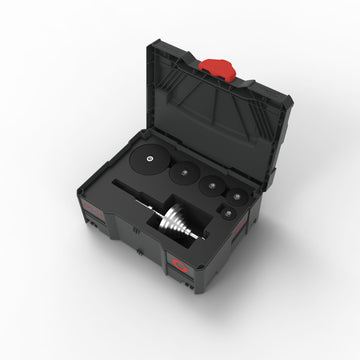
The Orbimax Standard Tee Pulling Kit is designed for fast, repeatable branch formation in stainless steel and copper applications. Heavy duty Acme threads, hardened pulling balls and optional saddles help fabricators achieve cleaner outlet formation with reduced finishing work prior to welding.
Explore the Orbimax tee pulling range here.
For higher production environments, automated and semi-automated fabrication systems are becoming increasingly important as workshops push to:
- Reduce labour hours
- Improve repeatability
- Standardise fabrication quality
- Increase throughput
- Reduce operator fatigue
- Minimise costly rework
The result is faster fabrication, cleaner fit-up and more consistent welding outcomes across every stage of production.

Why Purging Is Non-Negotiable
In high purity stainless welding, purge quality directly affects weld integrity.
Without proper purging, oxygen inside the pipe causes oxidation during welding, creating sugaring and contamination that can compromise corrosion resistance, reduce flow efficiency and fail inspection standards.
In critical cooling and process systems, that is not acceptable.
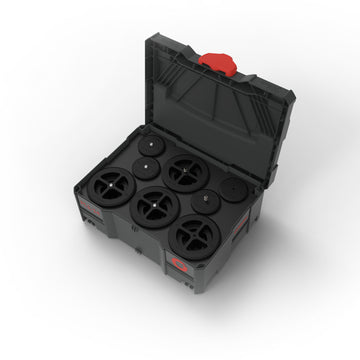
Orbimax purge systems are designed to maintain an inert atmosphere inside the pipe during welding, helping fabricators achieve clean, oxide-free welds with consistent internal quality.
Effective purging helps:
- Protect corrosion resistance
- Eliminate internal oxidation
- Improve weld quality
- Reduce contamination risk
- Meet inspection and QA standards
- Improve long-term system reliability
In high-spec stainless fabrication, internal weld quality matters just as much as external appearance.

Fit-Up: The Step That Defines the Result
Good welding starts with good alignment.
Even slight inconsistencies during fit-up can create stress points, penetration issues and alignment defects that become expensive to repair later in the project.
In data centre fabrication, where tolerances are tight and systems are expected to operate continuously, accurate fit-up is essential.
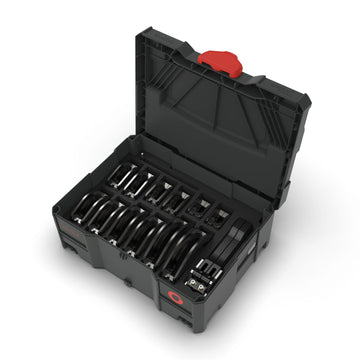
Orbimax alignment clamps and fit-up tools are designed to help fabricators achieve stable, repeatable positioning before welding begins.
Proper fit-up equipment helps:
- Improve alignment accuracy
- Reduce operator adjustment time
- Improve weld consistency
- Reduce distortion
- Minimise rework and repair time
On large-scale pipe installations, small fit-up inconsistencies quickly become major productivity issues. Reliable alignment systems help remove that variability from the process.

The Rise of Orbital Welding
One of the biggest shifts in modern data centre fabrication is the rapid adoption of orbital welding systems.
Unlike manual TIG welding, orbital systems automate the weld by rotating a controlled welding head around the pipe, delivering highly repeatable weld quality with reduced operator variability.
For critical stainless infrastructure, that consistency is becoming increasingly important.
Orbital systems help fabricators:
- Standardise weld quality
- Improve repeatability
- Reduce human error
- Increase productivity
- Achieve cleaner, more consistent penetration
- Meet demanding QA requirements
In environments where systems must operate continuously without failure, consistency is engineered — not left to chance.
Orbital welding does not remove skill from the process. It changes where that skill is applied. Successful orbital welding still requires deep understanding of parameters, purge quality, material behaviour and setup precision.
For modern fabricators, it represents the shift from manual welding toward precision-controlled fabrication systems.

A Complete System Approach to Welding
What separates data centre welding from general fabrication is not just the welding itself. It is the entire workflow surrounding it.
Every stage affects the next:
- Cutting
- Bevelling
- Alignment
- Purging
- Welding
- Inspection
Weakness in any one stage can compromise the final result.
That is why modern fabrication businesses are increasingly adopting integrated systems designed to improve consistency across the entire process, not just individual tasks.
Orbimax supports this approach with specialised equipment designed for high-spec stainless fabrication environments where quality, productivity and repeatability are critical.
Because on projects where thousands of welds are involved, consistency is not optional. It is engineered into every stage of the job.

Written by Aaron Hollingworth , Orbimax Operations Manager
Aaron has an extensive career in the automotive and general mechanical sales industry with leading national brands. As the Operations Manager with Orbimax, Aaron is responsible for sales, customer service and business development in order to deliver product knowledge, industry insight and an all-round exceptional customer experience for Orbimax customers.