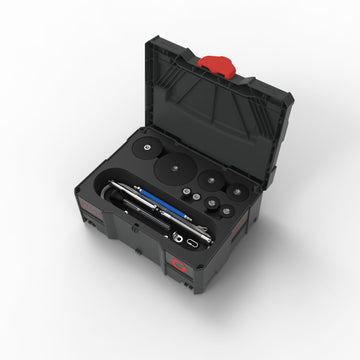
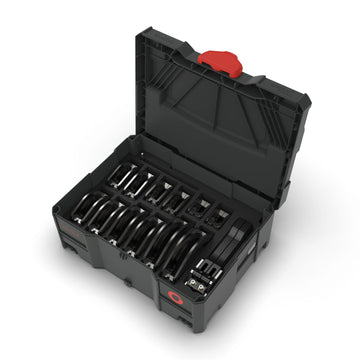
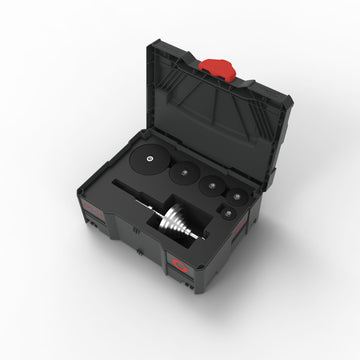
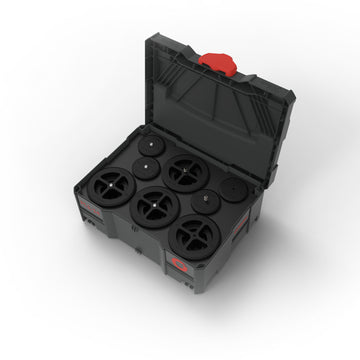
Electrochemical passivation provides a fast and highly controlled method for removing tarnish, scaling, and oxidation from stainless steel post-welding. The Orbimax PX Series utilises a high-current carbon fibre brush system to restore the metal's passive layer in a single step, which processes up to four times faster than traditional methods.
The Electrochemical Passivation Mechanism
The core of the PX Series system relies on the interaction between a continuous current, a highly conductive brush, and an active electrolyte fluid.
- Arc Cleaning: The equipment delivers continuous current to a brush head densely packed with millions of carbon fibres. This creates microscopic arcs at the tips of the fibres, physically stripping away heat tint, dirt, and manufacturing residues without altering the base metal.
- Fluid Dynamics: A specialised cleaning fluid (Electro-Chem) is applied, acting as an electrolyte to maximise electrical conductivity. As it evaporates during the process, it draws heat away from the workpiece to prevent overheating.
- Repassivation: As contaminants are stripped, oxygen released by the electrolytic action bonds immediately with the bare metal surface. This forces the immediate formation of a fresh, protective chromium-oxide film, fully repassivating the heat-affected zone (HAZ).
- Quality Standard: This specific passivation method holds certification from the German Federal Institute for Materials Research.
Equipment Specifications: PX70 EDGE vs. PX80 SMART
The series features two primary power units designed for different operational scopes: the lightweight AC-only PX70 EDGE, and the heavy-duty AC/DC PX80 SMART.
Fluid Management: The PX Auto Feed System
To address fluid waste and manual application inefficiencies, the PX Series is compatible with a patented, plug-and-play Auto Feed module.
- Active Energy Sensing: The Auto Feed unit draws power directly from the connected passivation machine and utilises a built-in sensor to monitor the exact cleaning energy being applied.
- Automatic Dosing: Based on the energy draw, the system calculates the exact volume of electrolyte required in real-time and pumps it automatically.
- Delivery System: The fluid is delivered directly into the carbon fibre brush via an acid-proof hose system integrated into the operator handle.
- Capacity Monitoring: The unit runs from a 5-litre feed canister equipped with a capacity detection sensor that triggers an alarm before the system runs dry.
Electrochemical Component Marking
Both machines double as electrochemical marking units capable of applying permanent, chemical- and abrasion-resistant identification.
- Marking Methods: Operators can choose between dark marking (which oxidises the metal surface) or light marking (which delicately removes a superficial layer of material).
- Resolution Limits: The system supports high-resolution long-term templates up to 2,400dpi, allowing for readable fonts as small as 4 points.
- Template Durability: Reusable long-term templates (maximum size 80x50cm) yield up to 10,000 applications. Standard label printer stencils are also supported.
- Substrate Compatibility: The marking process is effective on stainless steel, rust-sensitive steels, tool and carbon steels, aluminium, titanium, brass, bronze, copper, zinc, gold, and chromium/nickel-plated surfaces.
View the Orbimax Passivation P70/P80 brochure (pdf) here.